The Eternal Edge
You Have the Capital. You Still Need the Business. Three Ways to Put Capital to Work in Real Estate
November 24, 2026 · by Damon C. Healey
This week is for you if you already have the capital: a family office, an investment manager, a company with real estate needs, or a founder after an exit.
You do not need to raise. Your first decision is whose platform your money runs through. By platform I mean the business that finds, buys and runs the real estate.
There are three ways: invest through a sponsor, own the platform, or pay for someone else's platform. None of them is wrong.
The same $150 million, the first two ways
Same numbers as last week. They are illustrative and your terms will differ.
You have $150 million to invest. A lender covers 70% of the total cost and your money covers the other 30%, so together they pay for $500 million of deals, the fee at purchase included.
One: invest through a sponsor. A sponsor finds the deals, buys them and runs them, and you pay fees for it: here, 1% of the total cost at purchase and 1.5% a year on your $150 million while it is invested.
Two: own the platform. You hire the people and they work only for you. Say a team of seven plus outside firms. Call it $2 million a year, on top of the $150 million. Say the team takes a year to find the first deal.
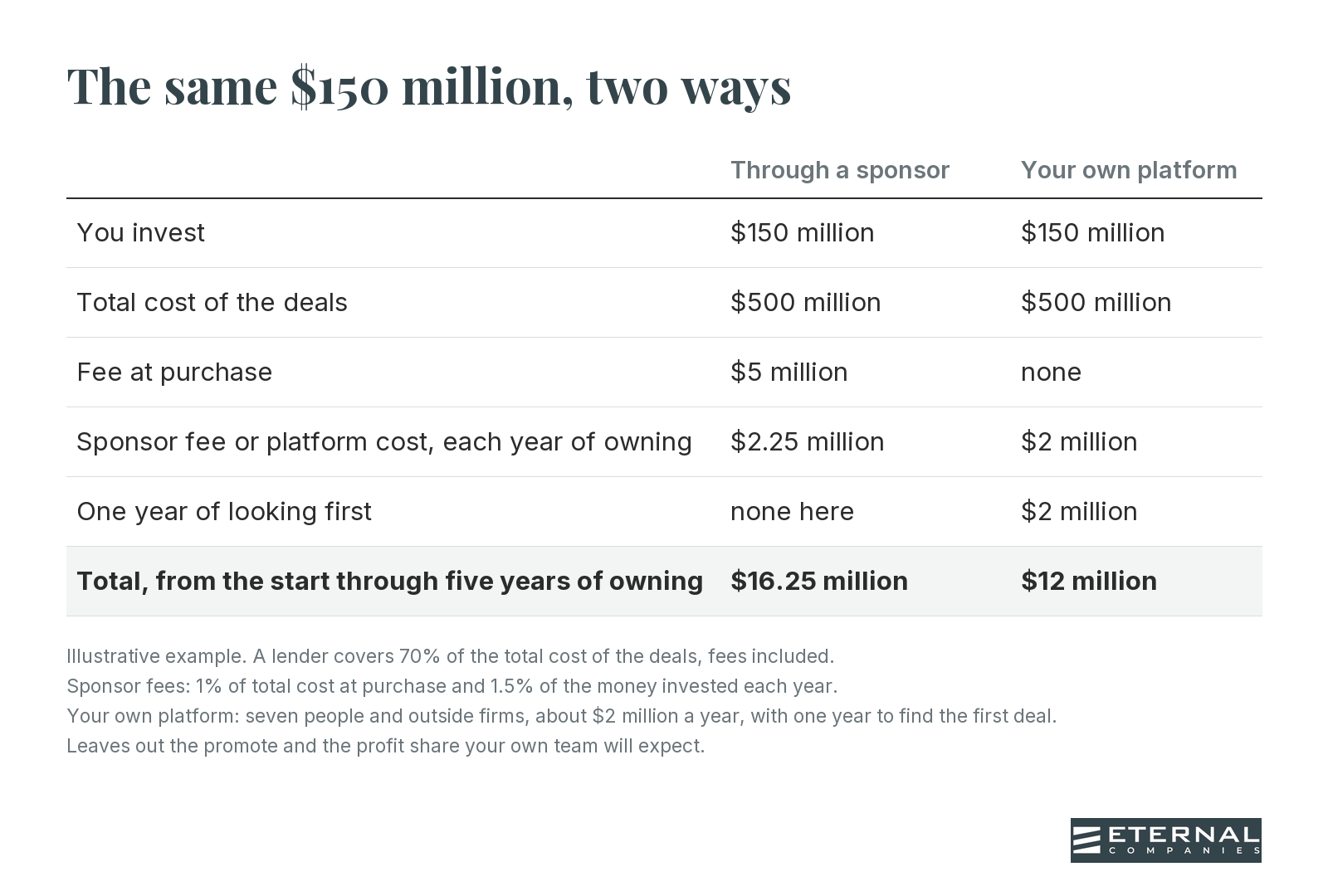
At this size, on these numbers, your own platform costs $4.25 million less. The sponsor's fees come out of the deals. Your platform's cost is a check you write on top. Either total is a drag on the return of your portfolio.
The answer changes with size, because the sponsor's fees grow with the money invested and, in this example, the team's cost does not. With $50 million, the same fee rates add up to about $5.4 million and the platform still costs $12 million. On these numbers, the two are equal near $110 million. Below that, the sponsor's fees are less than the team's cost. Above it, they are more.
The table compares fees with a team's cost and nothing else. It leaves out three costs: pursuit costs, the money spent on a deal before it closes; the promote, the extra share of profit a sponsor keeps above a target return; and the share of profit your own people will expect. It assumes the sponsor has a deal ready on day one, and it ignores what your $150 million would have earned during the year of looking. That year alone can cost more than the $4.25 million difference.
The other half of the decision is risk and control.
Through a sponsor, the sponsor takes the risk of finding the deals and pays the pursuit costs. If no deal closes, an independent sponsor has charged you nothing. When one closes, you typically reimburse the sponsor at closing for your share of those costs. In this example the sponsor costs more than your own platform, and that risk is part of what the extra pays for. You have less control over what the sponsor does and which deals it brings you. An independent sponsor brings you one deal at a time. If it does not bring enough of them, you go to other sponsors to invest the full $150 million. The alternative is an exclusive joint venture (JV) with one sponsor. In a JV the split of pursuit costs is negotiated once, up front, so the sponsor can pursue deals with confidence and nobody renegotiates each time. Whether to pursue a given deal is still decided deal by deal. The costs are typically shared pari passu, in proportion to the capital each side brings. If you bring 90% of the capital, you carry 90% of the pursuit costs and the sponsor 10%.
With your own platform, you own the business, so its risk, its liability and its results are yours. Your $150 million is at risk in the real estate either way. You pay the $2 million a year whether or not a deal closes, and you are closer to the day-to-day than you would be with a sponsor. If the team fails, you have lost the time and the money. But you have the control to change it: your own strategy, your own pipeline of deals and people who answer to you. If a sponsor fails you, you have to find a new one, though there are many to choose from.
Three: pay for someone else's platform
You find an operator whose strategy and team you believe in, and you write a seed check that covers their overhead while they get started. In exchange you get the exclusive right to finance the deals they source and manage. You are paying the platform's costs up front against fees your own capital will produce, if the team does its job.
The seed can be debt or equity. As debt, it is repaid as negotiated: out of the fees the platform earns, out of its promote, or both. The promote is typically paid at the last step of the waterfall, the order in which a deal pays out its cash, after you have received your capital back and a preferred return, the return a deal must pay you before the operator shares in the profit. As equity, you take a stake in the operator's company and receive your percentage of what it pays out to its owners, whether the money came from fees or from promote.
Use the example, with the seed as debt. Your seed is $2 million for the year of looking, on top of the $150 million. Then your deals close and the platform earns the same fees a sponsor would: $16.25 million over five years. It costs $2 million a year to run, $10 million over the five years. That leaves $6.25 million. In this example $2 million of it repays your seed, with no interest, and the other $4.25 million stays with the operator.
If the seed is repaid, you wrote a $2 million check and got $2 million back. What you paid is the fees: the same $16.25 million as through a sponsor, not counting the year of looking. And you have had exclusive rights for as long as the agreement runs. If no deal closes, there are no fees to repay it from, and you may never get the seed back.
Many groups count the seed inside the $150 million. They treat it as part of the allocation and accept that it lowers the return on the whole, in exchange for the exclusive rights and whatever say over deals, hiring and the budget they negotiated.
If the seed is equity instead, your share of the fees on your own capital is a discount on what you paid, not new money. New money comes from fees and promote on other people's capital, if your agreement lets the platform invest it, or from selling your stake. All of it is negotiable, and none of it is yours until it is written into the agreement.
Where I have seen it
I have worked inside all three.
When Lidl entered the United States, it had the capital and needed the business. It chose the second way. I joined as its fifth U.S. employee and built the real estate function: a 30-person team in 12 markets. Lidl needed stores, in volume, for years. Capital does not substitute for capability, so it owned the team.
Brookfield also chose the second way. It had its own capital, and I was part of a platform company it wholly owned.
I have been on the other side of the third way. I was part of an emerging manager, an investment management and development firm that received seed capital in exchange for equity.
And at Eternal, we are the first way. We act as a traditional sponsor, raise capital from different capital providers, and have entertained JV and seed capital opportunities.
Before the money goes in
Settle three things first:
- How much capital will go through the platform, and over how many years. Run the five-year math at your own size.
- What your up-front money buys. In your own platform, a business you own. In someone else's, repayment, a stake or both. Write down the percentages, whether they are counted before or after the platform pays its own costs, and how long they last.
- Who decides, and what happens if the deals do not come. Who decides on each deal, on hiring and on the budget. How long you keep paying, and what you own if you stop.
Some groups start with one experienced person before they build a team or back one. That person sets the strategy and the budget and helps decide which of the three ways fits. I take that seat. If you are weighing any of the three, reply and tell me where you are.
Happy Thanksgiving.
-Damon
Damon C. Healey, Founder, Eternal Companies
If you own or operate hotels or commercial real estate and want to grow beyond one deal at a time, book a 20-minute call, or write to me at [email protected] and tell me what you want to grow.
I read every reply.
Topics: real estate platform builder, real estate sponsor GP, family office real estate platform, seed capital real estate sponsor, emerging manager advisory, Platform Edge advisory