The Eternal Edge
Your Deal Made Money. Did Your Company? What Sponsor Fees Pay For in a Real Estate Platform
November 17, 2026 · by Damon C. Healey
Most owners I talk to grew one deal at a time. A few built a platform. Neither way is wrong, but they pay for different things, and you should know the difference before your next deal.
One deal at a time works like this. You and a few partners pool your own money. Some of you bring the know-how and some bring the capital. You buy a property, and the cash left each year after the loan payment is split among you. If no cash is left, there is nothing to split.
A platform can start with the same partners and the same kind of deal. This time they put a strategy around it, build a pipeline of similar deals and raise most of the money from outside investors. The partners become the sponsor, also called the general partner (GP): the group that finds the deal and does the work.
The same $30 million, two ways
Here is a simple example. The numbers are illustrative and your terms will differ.
Four partners have $30 million between them. A lender covers 70% of the total cost of each deal, which includes the price, closing costs and any fee paid at purchase. Each property pays 8% a year on the money invested, after operating costs and the loan payment and before any fee to the sponsor.
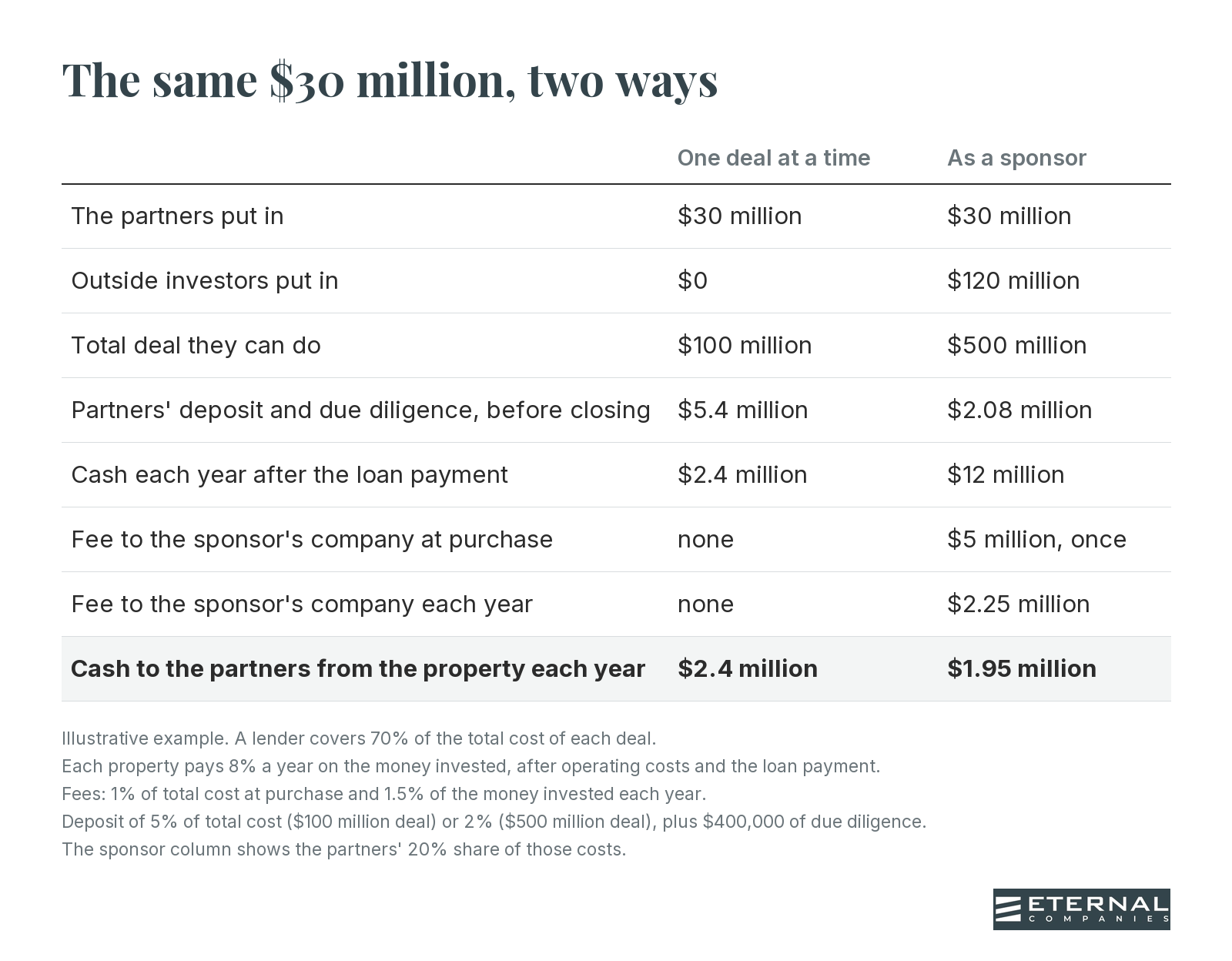
One deal at a time, the partners are the only owners of a $100 million deal and keep all of its cash. In this example they charge no fees, because they would be paying themselves.
As a sponsor, the same $30 million is 20% of the $150 million invested in a $500 million deal. The partners get 20% of the cash left after the yearly fee. In most deals they also earn an extra share of the profit if the property beats a target return. I am leaving that out to keep this simple.
Both ways, money goes up before the deal closes: a deposit, plus about $400,000 for inspections, reports and lawyers, known as due diligence. Call the deposit 5% of the total cost on the $100 million deal and 2% on the $500 million deal, because larger deals usually post a smaller share. One deal at a time, the partners put up all $5.4 million. As a sponsor, I am assuming the $10.4 million is split the way the deal is, 80% from the investors and 20% from the partners. Sometimes investors expect the sponsor to put up all of it first. When the deal closes, that money counts toward what each side put in.
I bought my own hotels in 2024 with outside money. One partner provided 80% of the money above the loans, with the intent to do more deals together. I could not have bought at that size alone.
What the fees pay for
When investors put in most of the money, they agree to pay the sponsor for doing the work. An acquisition fee is paid once, when the property is bought. Here it is 1% of the total cost. An asset management fee is paid every year for overseeing the property and reporting to investors. Here it is 1.5% of the money invested. Some sponsors also charge development, construction, financing and disposition (sale) fees, depending on the work involved.
Those fees are the income of the sponsor's company before they are anyone's profit. They pay for the people, the office, the software, the lawyers and accountants, and the deals you chase and do not win.
Fees alone do not make a platform. A sponsor can raise outside money and collect fees on a single deal. A platform is a business investors can put money into again and again: a strategy, a team and a pipeline of next deals. The fees are how that business gets paid for.
The deal made money. Did the company?
Now look at the sponsor's column as a business.
Say two of the four partners are active in the company, with three key staff from mid-level to executive and two analysts. Outside firms are hired for the rest. With pay, benefits, office, software, lawyers and accountants, call it $2 million a year.
The company earns nothing until its first deal closes. Until then, the partners pay for the company out of their own pockets. Their $2.08 million share of the deposit and due diligence is separate. It becomes part of their $30 million in the deal.
At closing, the company earns its first money, the $5 million fee paid at purchase. How far that goes depends on how long the partners carried the company to get there. At $2 million a year, two years of looking for the deal uses $4 million of it.
After closing, the yearly fee from this deal is $2.25 million. That covers the company with $250,000 to spare.
The property pays out $12 million a year. Of its $2.25 million yearly fee, the company keeps $250,000 after its own costs. One deal keeps this company open. It leaves little room to hire, to chase the next deal or to lose one. When the property is sold, the yearly fee stops.
A second deal like this one doubles the yearly fees to $4.5 million without doubling the cost of the company. The larger the portfolio, the easier it is to carry the company. Each new deal also takes more of the partners' own money, or a smaller share of the deal.
This is the reason investors ask how many more deals you have, which I wrote about last week. They want to know the company will still be standing for the second deal and the third.
Before your next deal, do this math on your own company:
- Add up what the company costs to run for a year. People, office, software, lawyers and accountants, and deals that do not close.
- Add up the fees one typical deal pays each year. Leave out the one-time fee at purchase.
- Divide the first number by the second and round up. That is how many deals your company needs running at once before it pays for itself.
There is one more way to pay for the company. A group that already has the capital can pay the company's costs up front, so its pool of capital has a company to invest through. I'll discuss this in next week's letter.
Reply and let me know if you need perspective on building your platform, or on making sure you are building it profitably.
-Damon
Damon C. Healey, Founder, Eternal Companies
If you own or operate hotels or commercial real estate and want to grow beyond one deal at a time, book a 20-minute call, or write to me at [email protected] and tell me what you want to grow.
I read every reply.
Topics: real estate platform builder, real estate sponsor GP, sponsor fees real estate, asset management fee, emerging manager advisory, Platform Edge advisory