The Eternal Edge
The New Loan Won't Pay Off the Old One: Why a Leased-Up Building Can Fall Short at the Construction Loan Takeout
November 3, 2026 · by Damon C. Healey
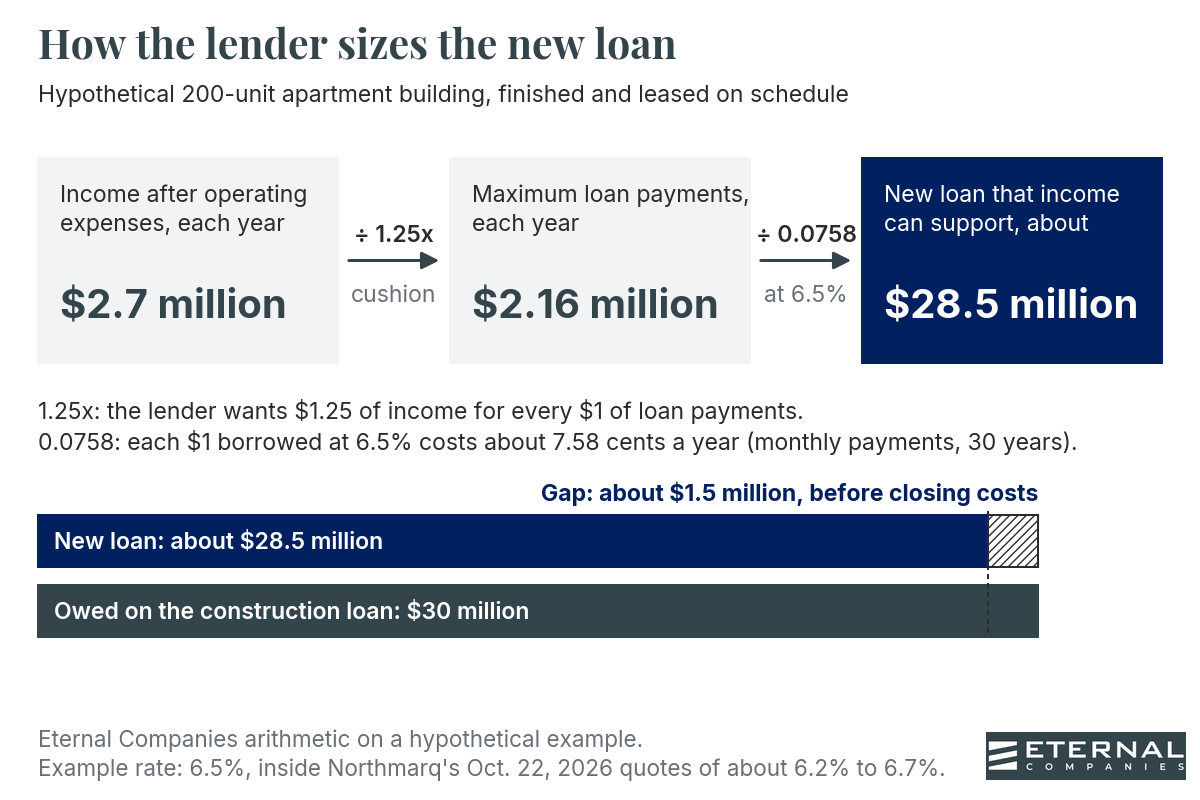
Last week I walked through five seats at the table, from the owner who needs a new loan to the bank that holds the old one, and promised you a sixth: the developer's. If you are building, this letter is about the day your construction loan comes due. I tell owners and investors the same thing: just because you have 90% occupancy doesn't mean you're making money. A finished building can have a different problem. It can be making money and still not qualify for a new loan large enough to pay off its construction loan. What happens when the building is finished A construction loan is short-term money that pays for the building while it goes up. The plan is to pay it off with a permanent loan, the long-term mortgage, once the building is finished and leased. Lenders call that handoff the takeout. The permanent lender does look at how full the building is, and it can hold back part of the loan until the building is leased. But a full building is not the test. The lender asks how much income the building actually produced after operating expenses (staff, utilities, repairs, insurance, and property taxes), before any loan payments. Then it asks whether that income covers the new loan's payments with room to spare. A common rule is 1.25 times (1.25x): $1.25 of income for every $1 of yearly loan payments. The lender sizes the loan to fit that rule at today's interest rate. In September, I told builders to size the permanent loan again at today's rate and see whether it still pays off the construction loan. Here is what that can look like. One project, two changes Here is a hypothetical apartment building: 200 units, $50 million to build. The construction loan is $30 million, 60% of the cost. The 2022 plan assumed $3 million a year of income after operating expenses, before loan payments, and a permanent loan at about 5%. That income is 6% of the $50 million cost. The building finishes on time and leases up on schedule. Two things are different. First, the income. The National Apartment Association reported that yearly insurance costs rose from $502 per apartment in 2021 to $777 in 2024, up 55%. The increase is $275 per apartment, or $55,000 a year on 200 apartments. Many counties raise the property tax bill once a building is complete and worth more. And owners are offering rent discounts, called concessions, to fill apartments. The rental data firm RealPage found that 14.5% of apartments in established rental properties offered one in September, on average about six weeks of free rent on a 12-month lease. For this example, assume the building produces $2.7 million a year after operating expenses: $300,000, or 10%, under the plan. Insurance is $55,000 of that. The rest stands in for higher taxes and free rent; it is an assumption, not a total from those reports. Second, the rate. Fannie Mae and Freddie Mac, the two government-chartered companies behind many apartment loans, offer 10-year fixed-rate loans through lenders. The mortgage firm Northmarq's October 22 rate sheet quoted those loans at about 6.2% to 6.7%. Those are quotes, not firm offers. Say 6.5%. The rate is fixed for 10 years, and the loan comes due then. The payments are figured as if you had 30 years to repay, so a balance is still owed at year 10. At 1.25x, $2.7 million of income leaves $2.16 million a year for loan payments. At 6.5%, each dollar borrowed costs about 7.58 cents a year in interest and repayment, so that supports a loan of about $28.5 million. Lenders also cap a loan at a share of the building's appraised value; here that cap comes out higher, so the income test sets the loan. Against the $30 million owed, you are about $1.5 million short before closing costs.
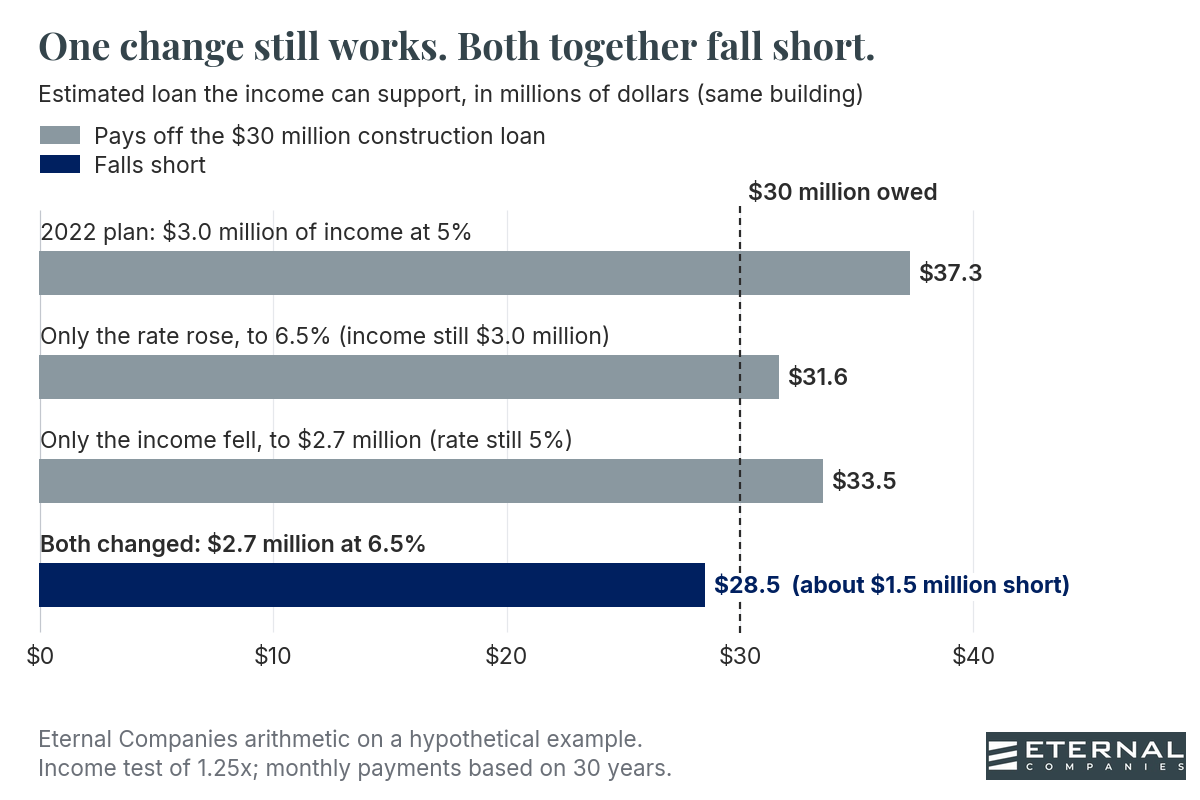
Here is the part I see developers miss. If only one of those two things had changed, the takeout would still work. Together, they open the gap.
The full $3 million of income at 6.5% supports about $31.6 million. The lower income at 5% supports about $33.5 million. Both clear the $30 million owed. And the gap can grow: at 6.75%, the same $2.7 million supports only about $27.8 million. This is not one building The data firm CRED iQ looked at $136 billion of apartment loans coming due from this fall through 2028: loans through Fannie Mae and Freddie Mac, plus loans packaged into bonds, not every apartment loan. Under its own rate and income assumptions, for loans written in 2021 and 2022, the new loan would not pay off the old one on 57% of the dollars coming due. That is the share of dollars with a gap, not the size of the gap. Those are existing buildings with years of income behind them. A project finishing now has only a few months of actual income, and the lender decides how many of those months to count. What I would do 12 months before completion
Leasing up is not the finish line. The takeout is. If you have a project finishing in the next 18 months, which number worries you most: A, the rate; B, the income; or C, the cash to cover a gap? Reply A, B, or C. -Damon Damon C. Healey, Founder, Eternal Companies If you own real estate and need help preparing your deal for investors and lenders, reviewing their terms, or deciding whether to grow, bring in a partner, or sell, write to me at [email protected] and tell me what is stuck. I read every reply. |
Topics: construction loan takeout, construction to permanent loan, refinance gap, multifamily permanent loan rates, real estate sponsor GP, Platform Edge advisory